Thursday, November 17, 2016

SUSTAINABLE NEIGHBORHOODS AND COMMUNITIES

While designing sustainable, it is also important to consider the region in with the design will be placed. A few of them are the land-use and regional settlement patterns, streets, and transportation systems. A sustainable community can be defined as a city, town, or neighborhood that is built in a way where the resources are used to its maximum potential. A community ought to seek a better development in the environment for the sake of mankind and the Mother Earth herself. 

In the 1990s the Smart Growth movement came about as a reaction to suburban sprawl. The purpose was to set guidelines to conserve communities. 

These rules are followed by 10 principles:


  1. Create housing opportunities and choices that provide quality housing for people of all income levels.
  2. Create walkable communities in places that are desirable to live, work, learn, worship, and play.
  3. Encourage community and stakeholders collaborations to where it is desired to develop growth.
  4. Foster distinctive attractive communities with a strong send of place which will later give the community a response to architectural beauty and distinctiveness.
  5. Make development decisions predictable, fair, and cost-effect to be embraced by a private sector.
  6. Mix land uses because it is a critical component in achieving better places to live.
  7. Preserve open space, farmland, natural beauty, and critical environmental areas to improve the quality of life and guiding new growth in the communities.
  8. Provide a variety of transportation is key.
  9. Strengthen and direct development towards existing communities already served infrastructure seeking to conserve irreplaceable natural resources
  10. take advantage of compact building design, rather than incorporating compact as an alternative.


EVERYONE SHOULD SEEK A LEED CERTIFIES HOOD! AGREE?

THIRTEEN PRINCIPLES OF NEW URBANIST NEIGHBORHOODS, DEVELOPED BY ANDRÉS DUANY AND ELIZABETH PLATER-Z YBERK


THIS IS FROM BURKE, BILL KEELER, MARIAN - FUNDAMENTALS OF INTEGRATED DESIGN FOR SUSTAINABLE BUILDING (THE BOOK I AM READING. I FOUND THIS VERY INTERESTING AND THOUGH I SHOULD SHARE IT!

1. The neighborhood has a discernible center. This is
often a square or a green and sometimes a busy or
memorable street corner. A transit stop would be
located at this center.
2. Most of the dwellings are within a fi ve-minute
walk of the center, an average of roughly 1/4 mile
or 1,320 feet (0.4 km).
3. There are a variety of dwelling type—usually
houses, row houses, and apartments—so that
younger and older people, singles and families,
the poor, and the wealthy may fi nd places to live.
4. At the edge of the neighborhood, there are shops
and offi ces of suffi ciently varied types to supply
the weekly needs of a household.
5. A small ancillary building or garage apartment is
permitted within the backyard of each house. It
may be used as a rental unit or place to work (for
example, an offi ce or craft workshop).
6. An elementary school is close enough so that
most children can walk from their home.
7. There are small playgrounds accessible to every
dwelling—not more than a tenth of a mile away.
8. Streets within the neighborhood form a connected
network, which disperses traffi c by providing
a variety of pedestrian and vehicular routes to
any destination.
9. The streets are relatively narrow and shaded by
rows of trees. This slows traffi c, creating an environment
suitable for pedestrians and bicycles.
10. Buildings in the neighborhood center are placed
close to the street, creating a well-defi ned outdoor
room.
11. Parking lots and garage doors rarely front the
street. Parking is relegated to the rear of buildings,
usually accessed by alleys.
12. Certain prominent sites at the termination of
street vistas or in the neighborhood center are
reserved for civic buildings. These provide sites
for community meetings, education, and religious
or cultural activities.
13. The neighborhood is organized to be selfgoverning.
A formal association debates and
decides matters of maintenance, security, and
physical change. Taxation is the responsibility of
the larger community.

Source: The Thirteen Points of Traditional Neighborhood
Development, New Urbanist Design, available for download at
http://newurbanist.com/principles.asp.

BASIC ENERGY PRINCIPLES


It is known that heating cooling and lighting a building can either add or subtract heat. A basic understanding of how this works can benefit and come in handy when it comes to building sustainably.

Sensible: this is defined as heat that is dry. 

Latent Heat: is defined as heat that is released and absorbed by a substance during its change in phase.

Heat transfer: this includes conduction, convection, and radiation.
  • Conduction: physical contact in order for heat to be transferred. 
    • ex: feet touching a warm floor, hands grabbing a cold glass of water.
  • Convection: liquids and gasses absorb and contract as they lose heat by conduction.
    • ex: finding yourself under a shade during a hot summer day and feeling a cool breeze
  • Radiation: energy emitted by particles or waves.
    • ex: sun hitting your skin


HUMAN CONFORT IS ALWAYS KEY. CONSIDER CLIMATE--from warm to cold, to humid and a mixture of all.


Wednesday, November 16, 2016

INTEGRATED DESIGN


The type of design that includes architecture, structural engineering, and HVAC. It also integrates building life cycle. The aim is to build sustainable architecture, equivalent to Green Design, a term that seemed questionable. Every integrated design needs an understanding of materials, system, and spatial element.

Process

First and foremost, there needs to be an understanding of the project type, along with size and scale. Following is the guidelines of the master plan. Furthermore, the geographical site and where the budget is coming from. Of course, YOU ALWAYS WANT TO CONSIDER THE ENVIRONMENTAL IMPACTS: will it harm any surrounding animals, wetlands, consider green land, water quality, and whether or not the construction will cause erosion. One must always understand the vulnerability of the site and community. So always ask questions and work with the team to work together in minimizing the disturbance of the environment. Materials are also a major consideration. Always be aware of the materials that can potentially be used, and avoid those that release toxicity in the environment. 

There are a few questions that the book I am reading has in order for one to ask before designing and integrated design. They are very helpful questions and here are several that will come in handy when thinking about the scope of the project.


  • Is the project an urban infill or an open space development?
  • Is there a riparian corridor on the site?
  • How will portable water be affected?
  • What is the current pattern of water runoff?
  • Does storm water percolate and drain into the water table or a body of water nearby?

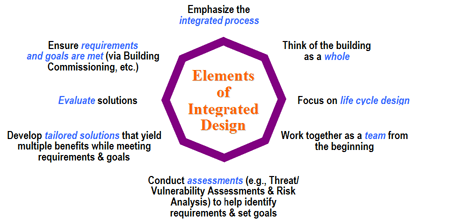
THIS CHART IS ALSO HELPFUL:


Elements of integrated design: Enphasize the integrated process, Ensure requirements and goals are met, Evaluate solutions, Develop tailored solutions that yield multiple benefits while meeting requirements and goals, Conduct assessments to help identify requirements and set goals, Work together as a team from the beginning, Focus on life cycle design, Think of the building as a whole.


For more information about Integrated Design, CLICK HERE.

RAINWATER


Rainwater harvesting is the collection of rainwater for use later. This occurs normally by storing water from roofs into tanks. Water is our most natural resource and we must do what we can to reduce the creation of new dams and reduce the stress in existing dams. It is super beneficial for us all, especially in dry places.

ALWAYS CONSIDER ROOF MATERIALS, AND DO CHECK OUT THE LINK BELOW TO LEARN MORE ABOUT RAINWATER COLLECTION! 


15: Water Quality and Water Conservation

1972: Congress passed the Clean Water Act (CWA).

This act was passed to regulate the discharge of pollutants in waters: oceans, rivers, bays, lakes, streams.
It also includes storm-water regulations across the country to ensure that the requirements of storm-water are appropriate to the cities geography, climate and patterns of development. 

The concerns of pollutants are an issue that had to be addressed because of the different types found in storm water. 

Concerns include sediment, organic matter, bacteria, oil/grease, heavy metals, toxic and synthetic chemicals: pesticides, plant nutrients: fertilizers and phosphorous.

Sediment comes from soil erosions that occur in bare areas on constructions sites. All areas contribute a huge amount of sediment. Dirt and dust from roads, roofs, and lots are also sediments that will wash off during rainy days, making its way to storm-water.

Organic matter is natural materials; for example, leaves sticks grass clippings, animal wastes and other materials such as paper, garbage, etc.

Bacteria that is made from animals that are able to crawl in sewage. Squirrels, mice and seagulls are just some of the animals that contribute and leave feces in these sewages that eventually runoff in stormwater.

Oil & grease from vehicles that leak creates some kind of lubricating agent that creates rainbow-like colors, contributing to storm-water pollution.

Heavy metals--such as copper, mercury, chromium, lead, iron, aluminum, manganese, boron, zinc and cadmium--come from vehicle emissions, weathering paints, wood preservatives, even minerals from rocks, soil and road salts accumulate and eventually affect sea creatures, and the folks who eat the sea mammals as well.

Toxic and synthetic chemicals have full effect on the biological conditions that threaten the aquatic life.

Plant nutrients sold in stores to help plants to grow contain phosphorous and fertilizers that can create undesirable  bacteria, plants and algae to grow.

Saturday, October 29, 2016

ECO-MINIMALISM RESEARCH

"THINGS SHOULD BE AS SIMPLE AS POSSIBLE -- BUT NOT SIMPLER."
ALBERT EINSTEIN


Eco-minimalism: is just a step forward in environmental, green building. It is the idea of living comfortably using the four elements effectively: air, water, earth (materials) and fire (energy).

Throughout the 20th century, we have been relying on technology to deal with air, artificial lighting and building materials (e.g. processed, composite).

As the current and future generations do their homework, over the changes we have to make in the way we build buildings, we can implement the idea of the well-being state of mind in every single individual with a greater mentality in environmental, cycle that we ought to seek. Using these four elements creates a cyclic flow--all elements coming together--enclosing to stay within the permits of our homes and commercial buildings. It begins with knowing where it comes from, how to use it, where will it go and using it to its maximum potential.


Fire Element:
Photovoltaic Solar Cells
Heat Pumps
Combined Heat and Power
Thermal Solar Collector
Condensing Boilers
District Heating

Air Element:
Conservatories
Small Wind Turbines
Mechanical Ventilation

Earth Element:
Green Roofs
Recycled Materials
Local Materials
Timber Cladding

Water Element:
Reed Bends
Greywater Recycling
Living Machines
Embodied Water
Rainwater Harvesting


The idea is less of the individual needs and more of the bigger environmental picture. In order to live harmonious balance with the environment, we must eliminate the unnecessary. 


References: Liddell, Howard. Eco-minimalism: the Antidote to Eco-bling 2nd Edition. RIBA Publishing Ltd, 2013. Print.